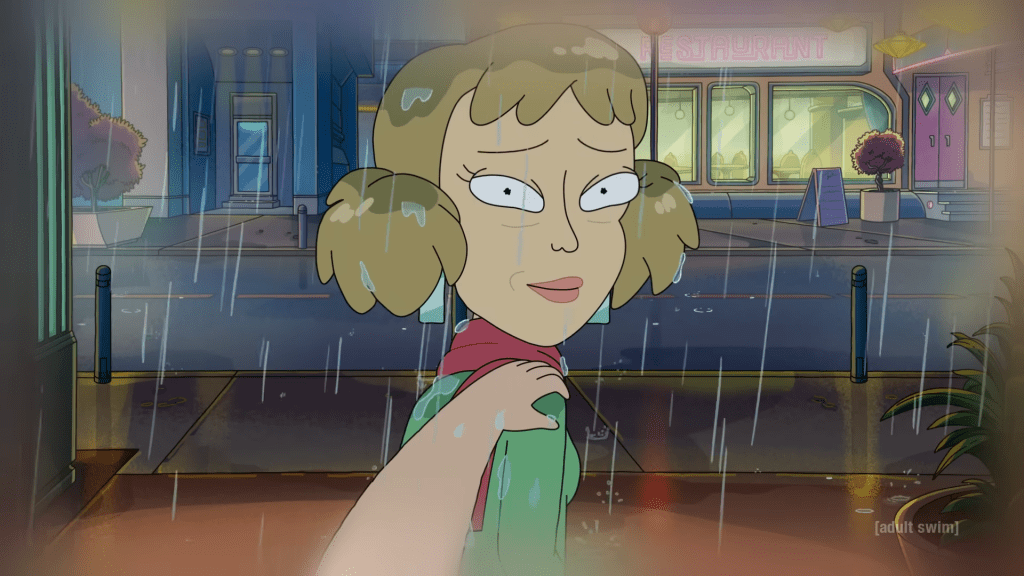
Many of the most poignant moments in the history of Adult Swim’s Rick and Morty are punctuated by powerful music tracks, and series composer Ryan Elder has a penchant for looping Lauren Culjak (stage name Kotomi) in when the show needs a female vocalist with a haunting voice to add the extra emotional punch.
The mournful and contemplative “Don’t Look Back” that plays at the end of the Season 4 finale is the most memorable song produced by their collaboration. The chillwave track plays while Rick reflects on his failures as both a father and a friend. When Elder got the script and animatic for Rick and Morty Season 7’s “That’s Amorte,” which called for a stripped down cover of a wistful Oasis song called “Live Forever,” he knew Kotomi had to be the one to do it.
“It was always going to be an acoustic version with a female vocalist,” Elder told me in an interview just before the episode aired on November 5. “Of course I thought of Lauren, aka Kotomi.”
“Live Forever” is a punchy song done in typical Oasis style, with a catchy tune and simple lyrics that convey exuberant emotions. Heather Anne Campbell, the episode’s principal writer, said on what’s left of Twitter that “Live Forever” was her favorite Oasis song.
The animatic Elder received had been temped with a “live, unplugged performance Oasis did of the song,” he said. The goal was to strip it down further to emphasize and wield the tender emotions at play, which was a bit ironic considering “That’s Amorte” has one of the show’s most gruesome and irreverent stories.
Rick’s “famous spaghetti” recipe involves harvesting the innards of natives that’ve committed suicide on an alien planet. A “suicidal amount” of cortisol increases the starch content in their bloodstream, resulting in a spicy-sweet hematoma that’s totally delicious to everybody else in the galaxy. The Smith family have been eating it for weeks at the start of the episode, but once Morty discovers the truth, his conscience inevitably leads to a galactic disaster.
With Morty as a consultant, the Spaghetti Planet’s president markets the suicidal pasta en masse, resulting in a global and intergalactic economy that encourages the planet’s natives to kill themselves to feed the frenzy. Morty persuades Rick to synthesize a substitute using one last volunteer.
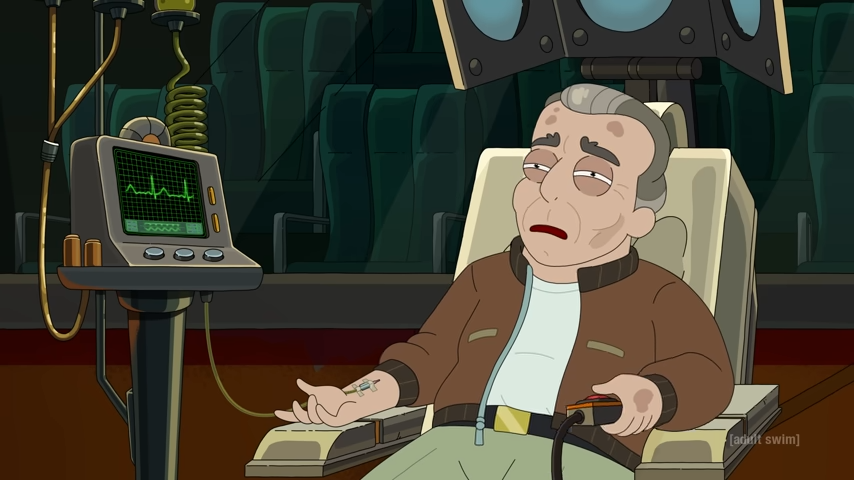
Enter Fred Bunks, a man with two months to live who sacrifices himself for the experiment. Rick’s euthanasia device also broadcasts a montage of the the man’s whole life to the entire planet. It’s a story of unfulfilled desire and frustrated dreams leading Fred to find love and success rather late in life only to lose his wife and become terminally ill himself. All the while, Elder and Kotomi’s “Live Forever” cover plays in its entirety while we witness devastating heartbreak and complicated joys in equal measure.
Read on to hear what they had to say about the experience of collaborating with one another yet again to elevate one of Rick and Morty’s more powerful emotional beats.
What was the process like creating this heartfelt track that plays over the montage of Fred Bunks’ life?
Ryan Elder: I got the animatic in January or February and that scene was already in there. I suspect that it was in the script because the episode is written by Heather Anne Campbell who is a genius and wrote the fortune cookie episode in Season 6. She was involved in giving us notes on the song and had a vision of how it was going to work from the very beginning. It was temped with a live, unplugged performance Oasis did of the song. It was always going to be an acoustic version with a female vocalist. Of course I thought of Lauren, aka Kotomi.
Our first pass was pretty different from what ended up in the episode. We initially went with more of a folky indie girl vibe like Taylor Swift’s folklore and evermore type or even a more stripped-down Phoebe Bridgers. I told Lauren to sing it airy and breathy in the style of Phoebe Bridgers. They wanted a little more bite and energy to it. We approached it with more of a strumming acoustic guitar rather than finger-picked.
Lauren Culjak: The original version was much more hushed vocally and really quietly song, which was a fun version to try. Then I put a little bit more energy and emotion into it, which ended up working better with the visuals. We also stacked some harmonies in there and I took some melodic liberties at the very last chorus. The full song is in there, so it was fun to be able to develop it as it progressed while staying pretty true to the original melody and chords.
How familiar were you both with the original track and Oasis going into the experience?
Elder: How could you not be? We’re both old enough to have heard this when it came out. It was freaking everywhere. I wouldn’t say that I understood the bones of it the way I do now, but I definitely understood the skin of it.
It’s like a deceptively simple song that’s just basically verse and chorus repeating over and over. But they tapped into something that’s very that that definitely resonates with the listener in a way that I think really works well for this scene.

Culjak: There were a few Oasis songs that I rocked out to pretty hard in middle and high school. And I definitely played “Wonderwall” as I was teaching myself to play guitar.
Elder: I was in college and an elitist music student who only listened to Phish and John Cage, stuff that I found intellectually challenging. For me, Oasis wasn’t a band I thought about too much. They were real poppy and towards the tail end of the alternative music boom. The beginning of that era were some of my most formative years as a music fan, so for me they weren’t intellectual or edgy enough. I didn’t pay attention until much later, but when I did, I realized there are some incredible songs and that these guys just write good music. They just do.
Culjak: Simple and good is not easy to create.
Something you said made me think of this, but Ryan would you describe Oasis as kind of basic?
Elder: Hmm. [laughing] In the sense that they are heavily influenced by one of the most influential bands in the history of recorded music? Yes. Anyone who does a “Beatles Thing” is going to be just a little bit basic.
But one of the reasons why I don’t love The Beatles like people who truly love The Beatles — and you can put this in there if you want — is because I was introduced to them secondhand through bands like Oasis before I really listened to The Beatles. By the time I got to The Beatles, they seemed old hat because I had heard all these bands that were ripping them off first.
So what do you both make of the lyrics to “Live Forever”? How well does it resonate with the scene from Rick and Morty?
Elder: Because they were going for a Beatles thing, there’s a fair amount of absurdity in the lyrics. There’s weird specificity that doesn’t resonate with me in particular. But there’s enough in there for me to bite into as a viewer with this scene. Part of what’s happening is that you’ve heard the song before and connect with it emotionally. The lyrics also tell a story of living a life well-lived, chronicling the ups and downs and how we might look back at all of it at the end.
Especially the part “maybe I will never be / all the things that I wanna be / now is not the time to cry / Now’s the time to find out why.” That is a very retrospective verse. It’s connecting the singer of the song to a specific person, whoever they’re singing to.
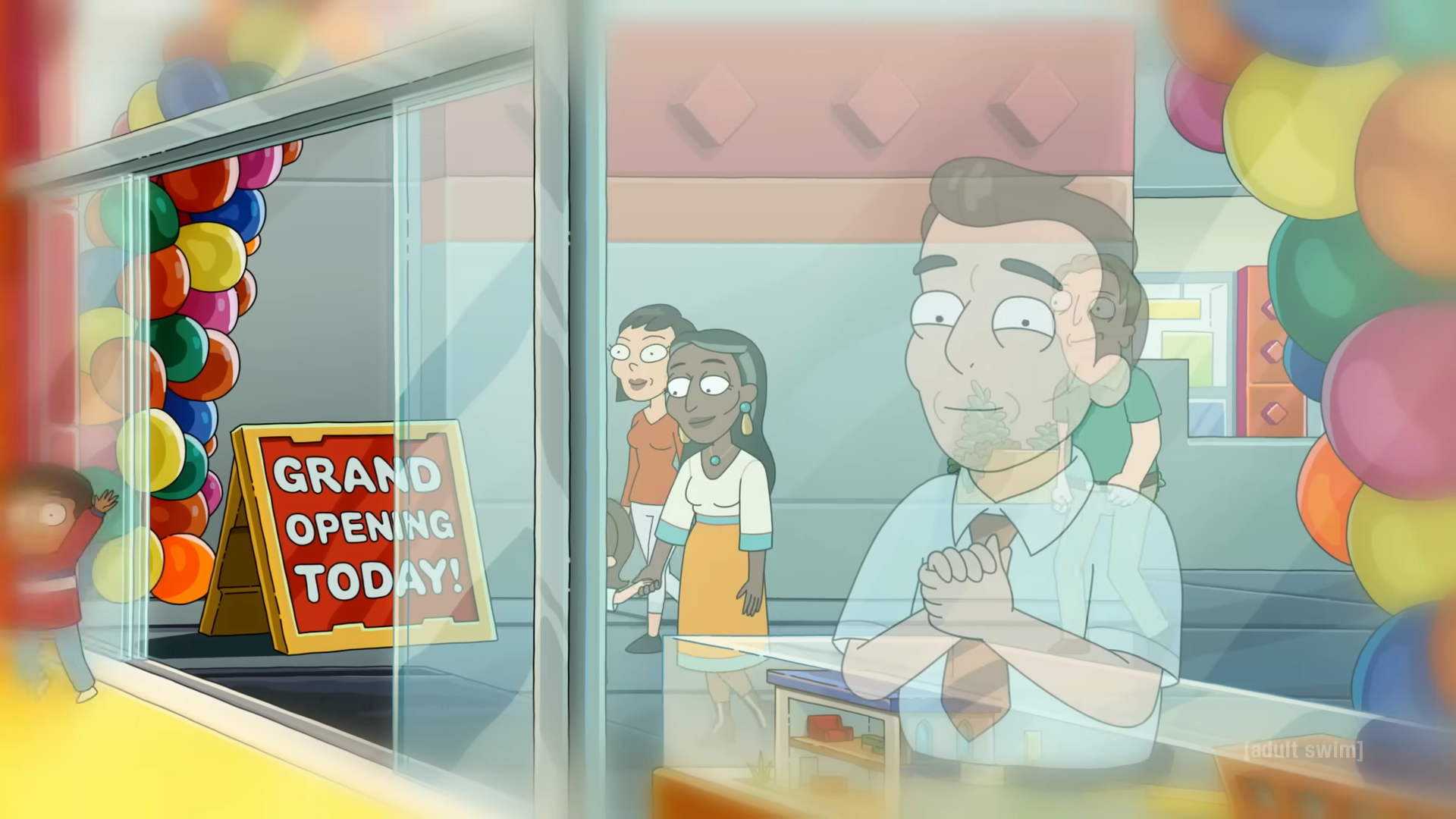
In this case, Fred is connecting with this woman who has been in his life for many years in some form or another. And it isn’t until later in life when Fred really got his shit together that he is able to connect with this person in a meaningful way.
He’s in a lot of pain, physically, but I the reason that he does want to die is because he’s not with this person who he loved and wanted to spend the rest of his life with. I can definitely relate to that as someone who has been married almost 20 years. And just last year, my grandma passed away. Her and my grandpa had been together for 60 or 70 years. Seeing the way my grandpa is dealing with life after my grandma is very poignant. The two and a half minute story in the middle of this insane episode resonates really well for me, in particular.
Lauren, how do the various versions of this song you tried resonate with your style?
Culjak: I was very attached to that first version. Currently, I’m really into the artists that we were trying to channel, so it was really fun to sing in haunted, hushed tone. But once I began singing, the second version, which was kind of pushing myself to sing out a bit more, it was maybe pushing the boundaries a bit for me.
I’m not like belting out a power ballad or anything. It’s still it’s still relatively mellow, but singing with more emotion felt better and made more sense knowing the context of what we were going to be scoring. Both were within the scope of how I like to sing at the quiet range or at the more dynamic and slightly more energetic emotional range. Both are very comfortable for me.
There’s a little bit more energy than the way I sing “Don’t Look Back.” I felt emotional as I was singing the version in the episode. Singing about life and death and wanting to live forever is an easy sort of emotion to tap into.
Elder: The strings weren’t even in the first version, so those brought out a lot of the emotion especially at the end.
Culjak: Absolutely, and you added a little bit of a pulse beat to it.
Can we expect any more cool Rick and Morty collabs in the future?
Elder: We will always collab no matter what in some for or another. We have at least three seasons of Rick and Morty after this one — hopefully many more. If there’s one thing Rick and Morty likes to do it’s to make an emotional moment with an emotional song.
Culjak: And we like doing that!
 Snippets